Wild Carrot
Irish Name: Meacan Bán Fiáin
Botanical Name: Daucus carota
My Story
"I am the wild carrot, the lace-maker of Irish meadows."
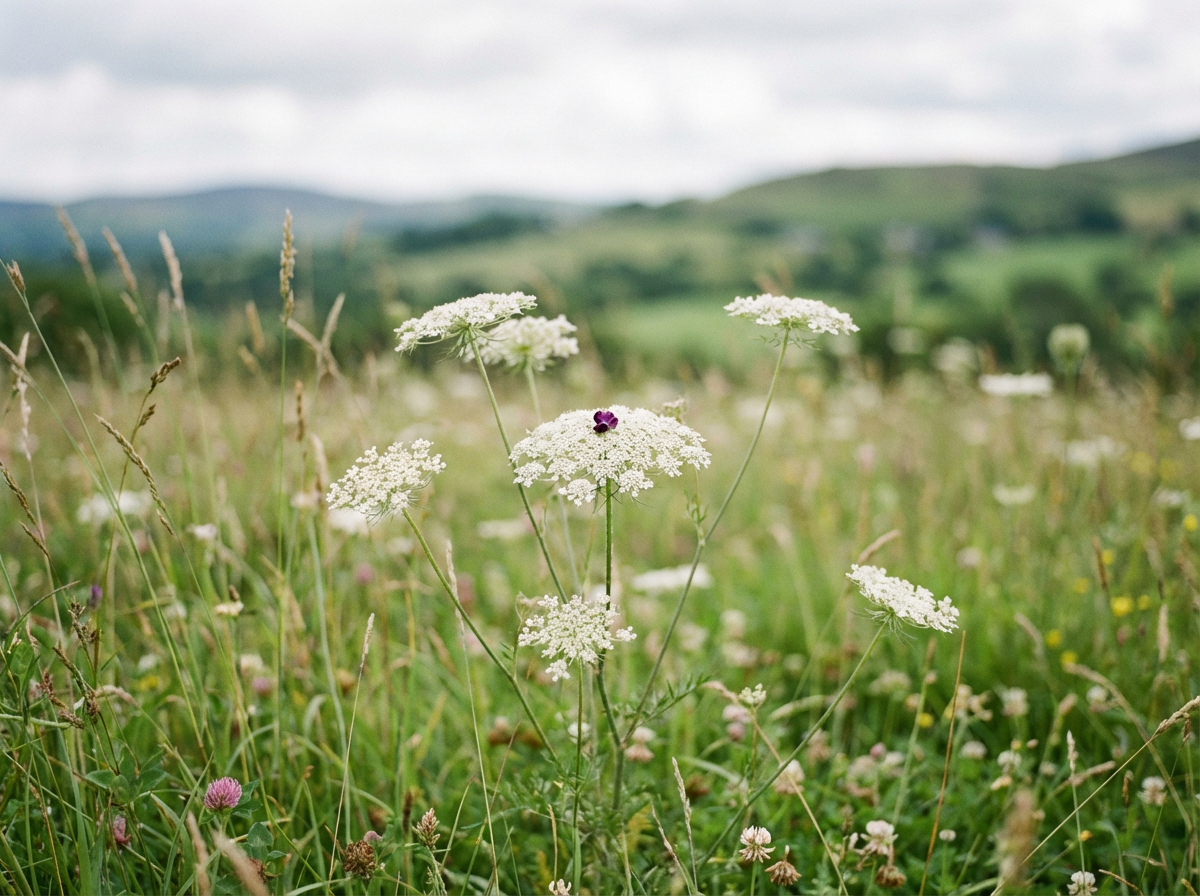
Look closely at my flower head and you'll see why people call me Queen Anne's Lace — each tiny white floret is arranged in an intricate, flat-topped umbel that looks like the most delicate handmade lace. And right at my centre, you might spot a single dark purple floret, like a tiny drop of ink on white cloth. That's my signature.
I'm the wild ancestor of the carrots you eat — yes, the very same! If you pull me up, you'll find a thin, pale root that smells unmistakably of carrot. But please leave me where I am. I'm far more beautiful standing in a meadow than sitting on a plate.
You'll find me along roadsides, in meadows, on clifftops, and in grasslands across Ireland. I love well-drained soil and sunshine, and I bloom from June right through to September, turning Irish meadows into seas of white lace.
My Home: Irish Meadows & Roadsides
I'm a plant of open, sunny places. You'll find me in grasslands, along country lanes, on coastal cliffs, and in meadows that haven't been too heavily managed. I'm a biennial — I spend my first year as a rosette of feathery leaves close to the ground, then in my second year I shoot up tall and burst into flower.
My flat flower heads are like landing pads for insects. Hoverflies, beetles, butterflies, and tiny wasps all visit me for nectar. I'm especially important for hoverflies, whose larvae eat aphids — so by feeding the hoverflies, I'm helping gardeners too.
After flowering, my seed head curls inward like a bird's nest — another of my many nicknames. These curled seed heads are beautiful in their own right, and they protect my seeds through autumn and winter until they're ready to disperse.
Folklore & Legend
The name "Queen Anne's Lace" comes from a legend about Queen Anne of England, who challenged her ladies-in-waiting to a lace-making contest. None could match the beauty of the wild carrot flower. When Anne pricked her finger while sewing, a single drop of blood fell onto the lace — and that, they say, is the tiny purple floret at my centre.
In traditional Irish herbalism, wild carrot was valued for its medicinal properties. The seeds were used in folk remedies, and the roots were eaten in times of scarcity. I've been part of the Irish landscape and culture for centuries — a humble plant with a royal name.
From Meadow to Jewellery
Wild carrot flowers are among the most beautiful to preserve. Each tiny floret maintains its delicate structure when carefully dried, creating intricate white patterns that look stunning in resin — like tiny snowflakes or lace doilies.
I collect them during peak bloom on warm summer days, choosing flower heads that are fully open and at their most symmetrical. Each one is pressed and dried slowly to maintain its lace-like beauty.
When set in crystal-clear resin, wild carrot becomes a piece of wearable lace — nature's own intricate design, preserved forever. The white flowers look particularly striking against dark backgrounds, where every tiny detail of their structure becomes visible.
Ethical Foraging Note
Wild carrot is abundant in Ireland, but I always forage responsibly — taking only a few flower heads from large populations and leaving plenty for pollinators and seed production.
Important: Wild carrot can look similar to other umbellifers, some of which are poisonous. Never forage wild plants unless you're confident in identification. The crushed leaves and root should smell distinctly of carrot.