Lesser Celandine
Irish Name: Grán Arcáin
Botanical Name: Ficaria verna
My Story
"I am lesser celandine, the golden star of early spring — I open my petals to the sun and close them when the clouds roll in."
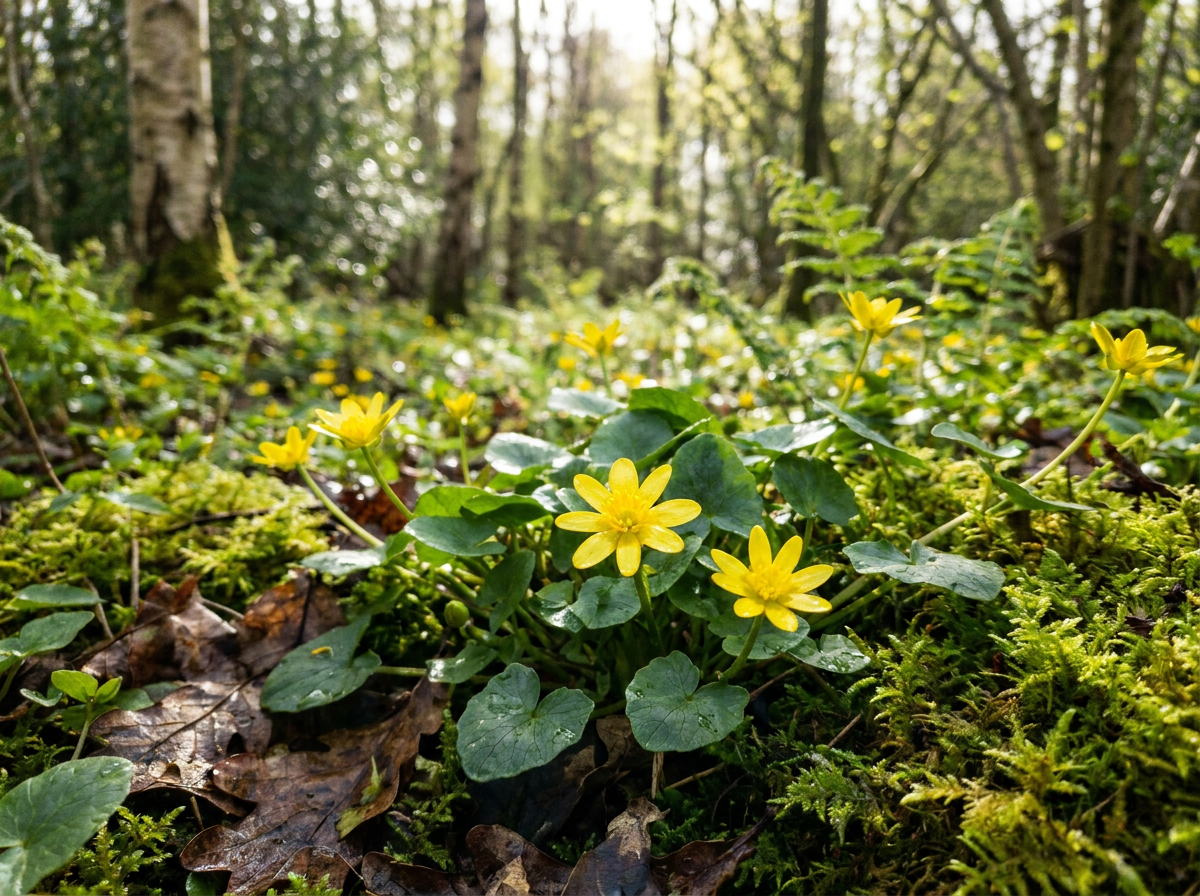
I'm one of the very first wildflowers to bloom each year, often appearing as early as February when the ground is still cold. My glossy, butter-yellow petals shine like tiny suns against the dark earth, and when I open in the morning light, it's like the woodland floor is scattered with gold coins.
My petals are extraordinarily shiny — almost lacquered-looking. This glossy surface reflects light in a way that makes me visible even in the dimmest woodland. I'm nature's own mirror, catching every ray of spring sunshine and bouncing it back.
I have a charming habit: I open my flowers in sunshine and close them in cloud or rain. Watch me on a changeable Irish spring day and you'll see me opening and closing like a tiny golden clock, tracking the sun across the sky.
My Home: Woodland Floors & Damp Banks
I love damp, shady places — woodland floors, hedgerow banks, stream sides, and the edges of ditches. I bloom early, before the tree canopy closes, making the most of the spring light. By the time the leaves are fully out overhead, I've already flowered, set seed, and retreated underground for the year.
My heart-shaped, dark green leaves are almost as distinctive as my flowers. They form dense carpets that can cover large areas of woodland floor, creating a lush green backdrop for my golden blooms.
I'm an important early food source for pollinators. Bees, hoverflies, and early butterflies visit me for pollen and nectar when few other flowers are available. My presence in a woodland is a sign of healthy, undisturbed habitat.
Folklore & Famous Admirers
Lesser celandine was the favourite flower of the poet William Wordsworth, who wrote three poems about me. He loved my cheerful, sun-tracking habit and saw me as a symbol of joy and resilience. When he died, a lesser celandine was carved on his memorial — though the sculptor accidentally carved a greater celandine instead (a completely different plant!).
In folk medicine, the plant was used to treat haemorrhoids — its tuberous roots were thought to resemble the condition, following the Doctrine of Signatures. This gave it the folk name "pilewort."
In Irish tradition, the early appearance of lesser celandine was seen as a reliable sign that spring had truly arrived. When the celandines opened, it was time to start thinking about the growing season ahead.
From Woodland to Jewellery
Lesser celandine flowers are stunning in resin. Their glossy yellow petals maintain their bright colour beautifully when dried, and their star-like shape creates a cheerful, eye-catching piece — like wearing a tiny piece of spring sunshine.
I collect lesser celandine during its brief spring bloom, choosing flowers that are freshly opened and at their most glossy. Each one is carefully pressed and dried to preserve the vivid golden colour.
Set in crystal-clear resin, a lesser celandine becomes a tiny golden star you can carry with you — a reminder that even in the darkest winter, spring is always on its way.
Ethical Foraging Note
Lesser celandine is very common in Ireland, often forming large colonies in woodlands and along hedgerows. I collect only a few flowers from abundant populations, leaving the vast majority for early pollinators. The plant spreads readily through bulbils and tubers, so picking a few flowers has minimal impact on the colony.