Rosebay Willowherb
Irish Name: Lus Creige
Botanical Name: Chamerion angustifolium (formerly Epilobium angustifolium)
My Story
"I am Rosebay Willowherb — the tall pink torch that rises from the cleared ground, the hedgerow spire that lights up the late summer. Where the land has been disturbed, I arrive first."
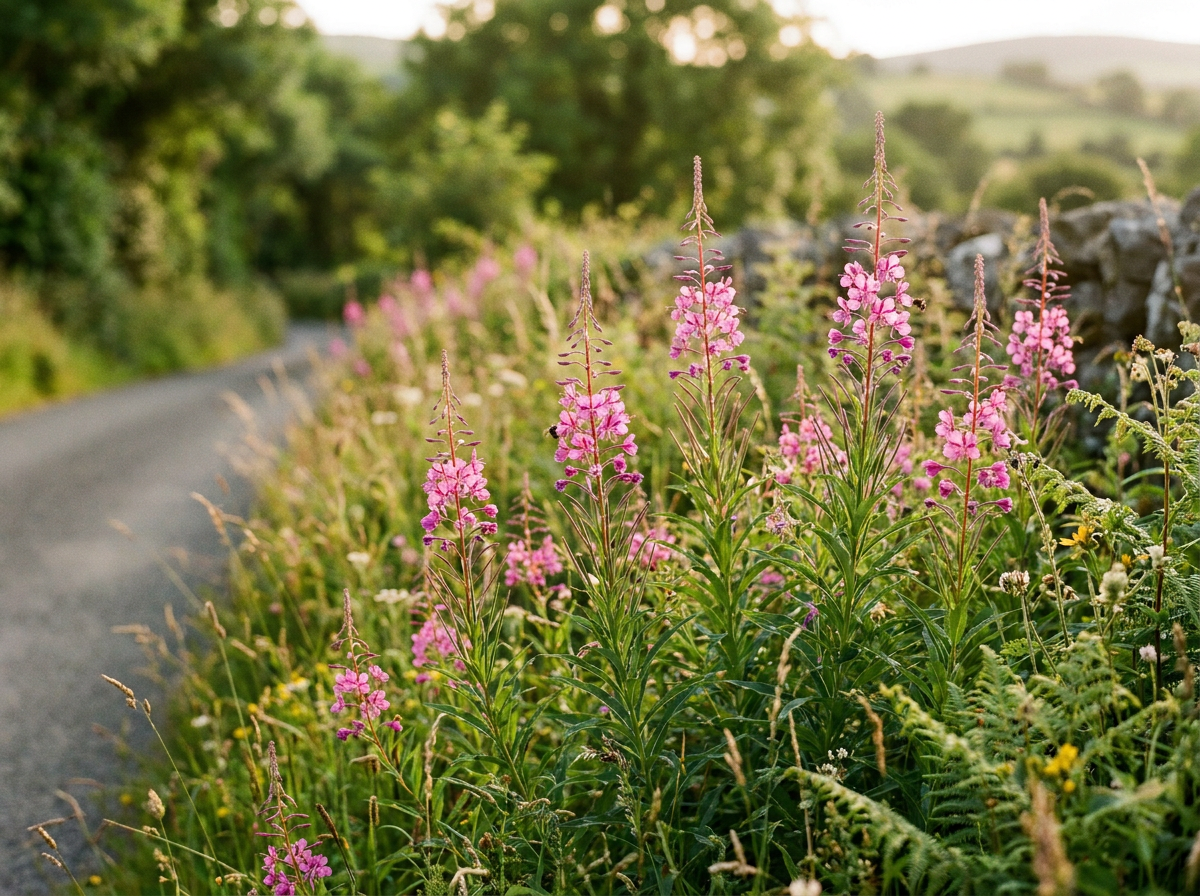
You'll know me by my height. I send up tall, graceful spikes — sometimes over a metre and a half tall — crowded with vivid pinkish-magenta flowers that open from the bottom upward, so each spike blooms for weeks. My four rounded petals, each with a slight notch, fan out around a pale centre, and my narrow, willow-like leaves give me my name.
I am one of Ireland's most striking native wildflowers, and one of the most opportunistic. I love sunlight and disturbed soil — woodland clearings, roadside verges, hedgerow edges, and the places where felling or fire has opened the canopy. I can't help it; I was made to follow the light.
By late summer my petals fall and my long seed pods split open, releasing thousands of tiny seeds, each carried on a tuft of silky white down. Drift on the wind, settle on bare ground, begin again. That's my way.
My Home: Clearings & Verges
I grow across every county in Ireland, most often where the land has been opened up — along forestry tracks, in recent clear-fells, on roadside banks, at the edges of new hedgerows, and in rough waste ground. Give me sun and a patch of bare soil and I will find it.
My flowers are a late-summer lifeline for pollinators. Bees, butterflies, and moths feed on my nectar when many other wildflowers have already faded. I'm particularly valuable for bumblebees building up their reserves before autumn, and for moths that fly at dusk. Hoverflies and honeybees visit me throughout the day.
I spread both by seed and by underground rhizomes, so once I find a spot I like, I often return in greater numbers the following year — a spreading colony of pink spires lighting up the edge of the wood.
Folklore & Traditional Uses
I carry many names. Across Britain and Ireland I'm often called "fireweed" — because of my habit of appearing in great numbers on ground scorched by fire. After the London Blitz, I famously colonised the bomb sites, springing up in vivid pink where buildings had stood. It made me a quiet symbol of renewal: the flower that returns after loss.
In Irish folk tradition, my silky seed down was sometimes gathered and used as a tinder for starting fires, or stuffed into bedding and pillows for warmth — a humble but useful role. My young shoots were occasionally eaten as a spring vegetable, and a leaf tea was used as a gentle remedy for stomach upsets and sore throats.
My rising pink spires have long suggested resilience and recovery. To see me bloom where the ground was bare is to be reminded that nature doesn't simply recover from disruption — it sometimes responds with its most vivid colour.
From Hedgerow to Jewellery
Rosebay Willowherb is a dramatic flower to preserve in resin. Each individual blossom — four pink-magenta petals around a pale centre — sits beautifully in a small piece, while a section of spike with several opening buds creates a striking cascade of colour. The vivid pink reads as genuine warmth in clear resin, never fading to flat colour.
I collect the flowers in high summer, choosing spikes where the lower flowers are freshly open and the upper buds are still tightly furled — that way the pressed piece carries both the open bloom and the promise of more to come. Each is pressed and dried carefully to hold the pink.
Set in crystal-clear resin, Rosebay Willowherb becomes a slice of an Irish late summer — the hedgerow at its most vivid, the season just before it turns. A small, wearable reminder that beauty often arrives strongest where the ground has just been opened to the light.
Ethical Foraging Note
Rosebay Willowherb is abundant and spreads readily by both seed and rhizome, so careful collection of a few flower spikes causes no harm to the plant or its colony. I gather only from large, thriving stands along tracks and verges — never from small or isolated patches — and I always leave plenty of spikes to set seed for the pollinators and the next year's growth.